The Arena
What a new Congress can and can’t do, tunnels under Nogales, the bipartisan money, and Checo’s 300th.
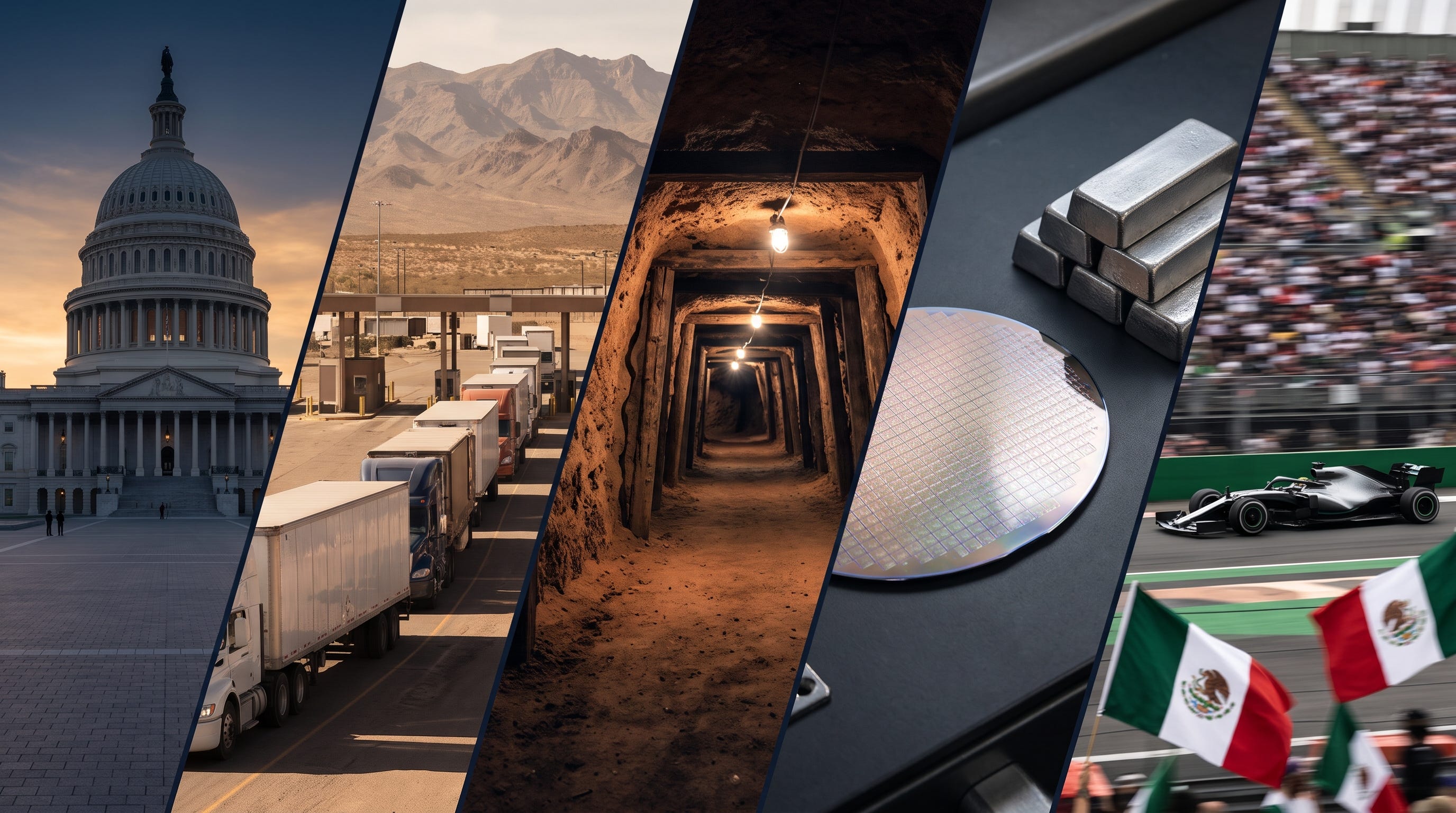
I spent this weekend at the Mexico City Grand Prix, surrounded by people who live by one rule: nobody wins from the stands. I talked with young Mexican drivers chasing Formula One, with the team builders who made Checo possible, and crossed paths with U.S. Ambassador Ron Johnson. Then came the election countdown. This week’s edition is about the people who show up: voters handing a new Congress a loan, not a mandate, the officers who sealed tunnels under the Nogales I grew up in, investors following the bipartisan money, and the next generation of Mexican drivers. Welcome to the arena.
Here is the edition.
First time reading? Join thousands of intellectually curious readers. Sign up here.
// POLITICAL ARENA
After Tuesday: a loan, not a mandate
Whatever happens on Tuesday, the hard part starts Wednesday morning.
Doug Sosnik, a friend since 2004 and a top strategist in the Clinton White House, said it well this week: people are underestimating how different our politics will look the day after. I value Doug’s counsel because he reads the numbers honestly, even when his own party won’t like what they say.
Democrats are favored to win the House and possibly the Senate. But Sosnik notes that the Democratic brand has barely improved, even as voters turned on the President. Voters are not embracing Democrats. They are firing Republicans. That is a loan, not a mandate.
Latino voters who swung toward Trump in 2024 are moving back, and the reason is blame, not loyalty. Our families vote on paychecks, rent and respect. If a new majority spends 2027 on subpoenas and impeachment instead of costs, wages and a working border, that jury will turn again.
There is a second warning. Sosnik expects a lame duck fight over December funding, a splintering Republican Party and an empowered left among Democrats. His bottom line: expect disorder. Disorder is expensive for border businesses that need predictable rules.
Then comes the real prize: 2028, the first open presidential race in 12 years. On the Republican side, JD Vance leads the polls, but Marco Rubio understands this hemisphere better than anyone in the field. Among Democrats, Gavin Newsom governs a border state with the largest Latino population in America. And watch Georgia on Tuesday. A strong night for Jon Ossoff, in a state built on ports and trade with Mexico, could make him the face of a new generation.
The campaign for 2028 starts Wednesday. So does the accountability.
// FROM MY WALLS
NO. 001
The one painting I never have to explain
Rita Amaya painted this in July 2023, and the original has hung in my office in Phoenix ever since. In three years not one diplomat, executive, or official has walked through that door and asked who it is. Villa ran both sides of this line as if the line were a suggestion, which is still the most honest description of this region I know. That is why the collection starts here.
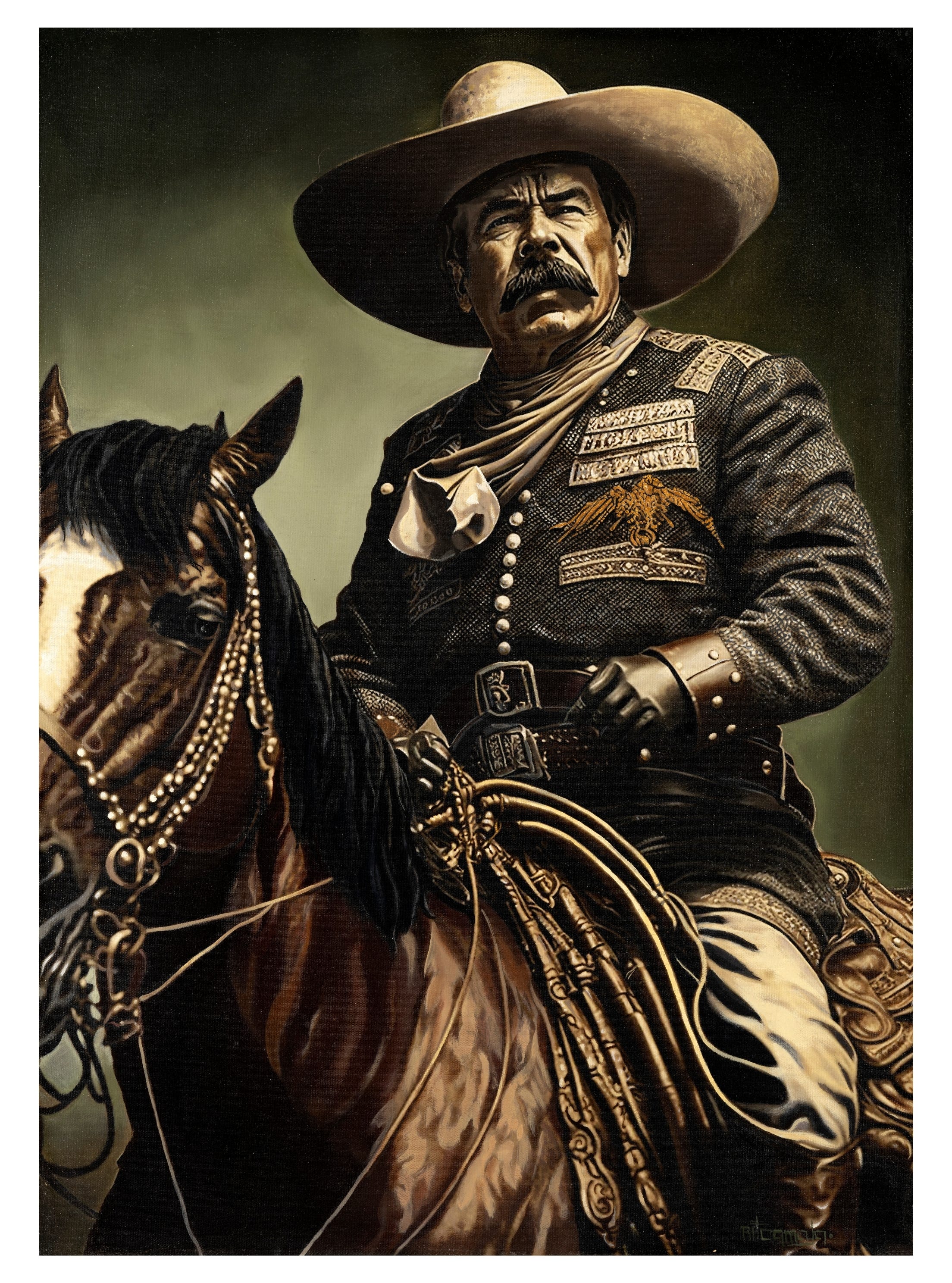
ARCHIVAL POSTER | 18 x 24 | $25 | SHIPS IN 5 TO 7 DAYS// TRADE WINDS
Tariffs don’t read election results
If you run a border business and you are hoping Tuesday brings tariff relief, here is my advice: don’t build your 2027 budget around it.
Mexico’s economy secretary, Marcelo Ebrard, said it plainly last week. U.S. tariff policy is unlikely to change quickly, even if the midterms shift power in Washington. He is right. These tariffs raise real revenue, and they were imposed by the President under national security authority. A new Congress can hold votes against them. Undoing them is another story.
Here is where things stand. Mexican vehicles face a 25 percent tariff, and steel and aluminum face 50 percent. Mexico wants no car tariff above 15 percent, the rate South Korea pays. Ebrard says about 80 percent of Mexico’s trade with the U.S. already crosses duty free under USMCA. But reporting suggests Commerce Secretary Howard Lutnick is resisting deep cuts, and Mexico is still waiting for an answer.
Meanwhile, a bigger clock keeps ticking. Because Washington declined to extend USMCA this summer, the agreement now faces annual reviews until a deal is reached or it expires in 2036. The next deadline is July 1, 2027.
Think about what that means on the ground. An auto supplier in Sonora, a produce importer in Nogales or a trucking company in Laredo cannot plan a 10 year investment around a one year review. Uncertainty is its own tariff.
At Intermestic Partners, the smartest clients I advise are not waiting. They are tightening rules of origin compliance, documenting U.S. content in their products and preparing for every scenario.
Tuesday matters. But on trade, preparation beats prediction.
// BORDER BUZZ
You can’t fill your way to security
I grew up in Nogales, a city that sits on top of the most tunneled stretch of our border with Mexico.
This week, federal prosecutors in San Diego indicted a man they call El Ingeniero for engineering a tunnel for the Jalisco New Generation Cartel. It ran about 1,933 feet from Tijuana to a supposed retail store near the Otay Mesa port of entry, with reinforced walls, rail, ventilation and electricity. What stands out is the charge: material support for terrorism, possible because Washington designated CJNG a terrorist organization last year.
Tunnels are not new. The first known one was discovered in May 1990, running from a house in Agua Prieta to a warehouse in Douglas. El Chapo hid its entrance under a pool table. That tunnel became the blueprint.
Nogales became the capital. Our two cities share a drainage system built in the 1930s, and smugglers learned to punch into it from both sides. Border Patrol counts about 127 tunnels in the Nogales area since 1990, more than half of all those found along the border.
When I was mayor, our Nogales police worked side by side with Border Patrol to find them, and the city had to fill and seal them, one by one. For every tunnel we closed, another crew was already digging.
Later, as Chief of Staff at CBP, with 60,000 people and a $13 billion budget, I learned a lesson that still holds: you cannot fill your way to security. It takes detection technology, binational cooperation with Mexican authorities, and prosecutions that reach the engineers and financiers, not just the diggers.
The terrorism charge sends a strong signal. Now we need the tools to match it.
// POWER MOVE
Follow the bipartisan money
Investors ask me the same question every election: what changes on Wednesday? This year my answer is less than the headlines suggest, and more than you think in a few places.
Start with what will not move fast. Tariffs stay. Even with a Democratic Congress, a presidential veto protects them, and Mexico’s own economy secretary is telling businesses not to expect quick relief. Price that in.
Now follow the money both parties already agree on.
Semiconductors. TSMC has committed $265 billion to Arizona, and since 2020 the state has drawn more than 70 chip expansions worth over $314 billion. No new majority is going to walk away from that.
Critical minerals. China refines roughly three quarters of the world’s cobalt, and the United States refines none at commercial scale. Washington is building a strategic minerals reserve with Export-Import Bank backing, and the Energy Department put $500 million into seven minerals companies in August. This is national security, the most bipartisan line in the budget.
EB-5. Here is the date most investors are missing. The EB-5 Regional Center Program is authorized only through September 30, 2027, so the Congress elected Tuesday decides whether it continues. Minimum investment amounts are also scheduled to rise in January. EB-5 has drawn support from both parties because it brings foreign capital and American jobs at no cost to taxpayers.
That is why I am proud of where Intermestic Capital stands. Our EB-5 fund is backing America’s first solar powered cobalt processing facility at commercial scale, in Yuma County, and it received USCIS approval on September 30. Its first investors were Mexican, and they are offered a fixed 9% return.
Elections change the noise. Strategy follows the signal.
// PLAYING FIELD
The next Checo is already racing
This weekend at the Autódromo Hermanos Rodríguez, Mexico reminded the world what a home crowd sounds like.
Yesterday Checo Pérez made his 300th Formula One start, at home, joining just six drivers in history. Starting near the back, he gained six places off the line before pit stop trouble dropped him to 17th. Results aside, a nation celebrated a milestone, and Cadillac has already signed him on for the years ahead. And Kimi Antonelli, just 20, finished third to clinch the title as the youngest champion in F1 history, breaking Sebastian Vettel’s record and becoming Italy’s first champion since 1953.
Some people see these weekends as a party. For me, they are a chance to learn from people who have built something extraordinary.
I spent time with Noel León in Formula 2, Ernesto Rivera, a Red Bull junior in Formula 3, and Sebastián Álvarez, who races at Le Mans, talking about their work and the grit it takes to get here. I caught up with Memo Rojas, one of Mexico’s most successful endurance drivers with 34 career victories, who now hosts one of the most listened to sports podcasts in the country. A good man, and a real supporter of young drivers like Noel.
I also spent hours with Jimmy Morales, who has had a front row seat for this entire journey. Jimmy, a former driver himself, built Escudería Telmex alongside Carlos Slim Domit in 2002, and he was the one who told Carlos that a young Checo had special talent. The vision has always been Carlos’. The execution has been Jimmy’s. I have been privileged to call them both friends since 2011.
Carlos also introduced me to Otmar Szafnauer, who helped lead Force India and its successors, Racing Point and Aston Martin, for more than a decade, then ran Alpine, and today leads Van Amersfoort Racing in F2 and F3. He was team principal when Checo won his first Grand Prix. His message stayed with me: most young drivers will never make it, but no one makes it from the stands. You have to be in the arena, something I have written about here many times.
And Mexico’s pipeline runs well beyond Formula One. Pato O’Ward of Monterrey has become one of IndyCar’s biggest stars, and Daniel Suárez, another Escudería Telmex driver, made history as the first Mexican-born winner in NASCAR’s top series. Different series, same formula: talent, backing and years of work.
That is the real lesson of this weekend. Champions take time, commitment, investment and vision, and the courage to show up.
The next Checo is already racing.
Never miss a beat from headlines to deep dives.
Thanks for reading Power Courier by Marco Lopez! Subscribe for free to receive new posts and support my work.
Discussion about this post